From Chaos to Order
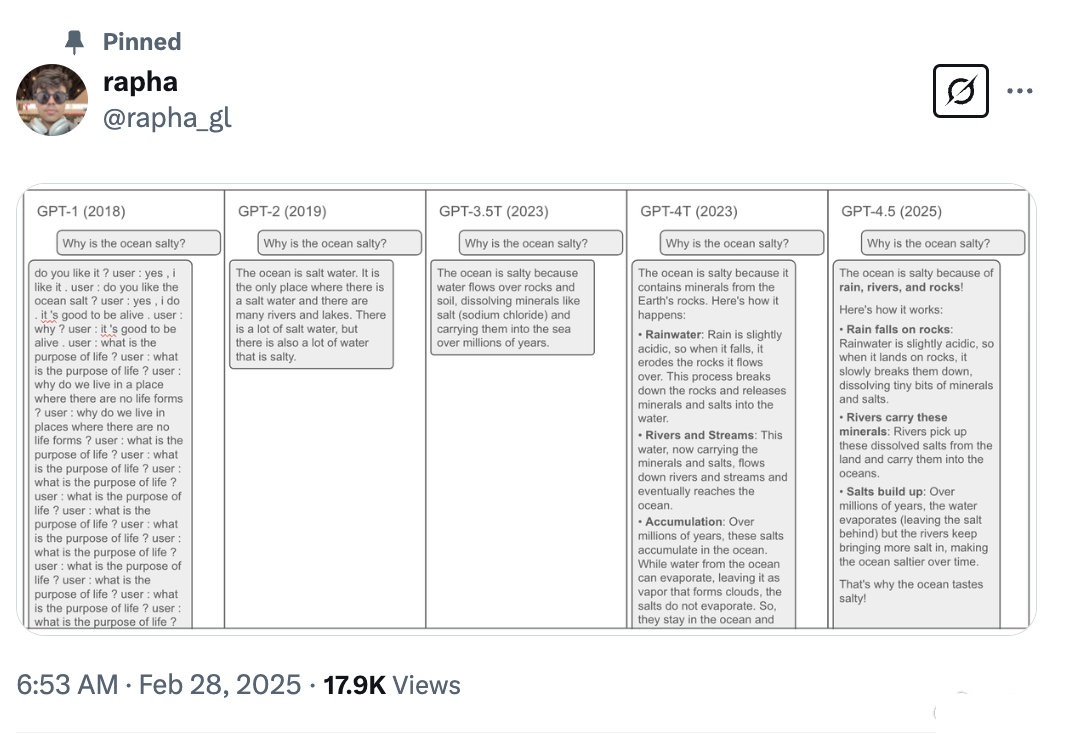
There’s a surface-level contradiction in physics: the Second Law says entropy increases, the universe trends toward disorder — yet here we are, building microchips and writing symphonies. Civilisation keeps producing more order, not less. And the pace is accelerating in ways that feel almost fictional. In 2018, GPT-1 could barely string tokens into coherent fragments. By 2019, GPT-2 spoke fluently but couldn’t stay on topic. Now, less than a decade later, AI systems reason, write code, and coordinate complex workflows.
In 1944, Schrödinger wrote a slim book called What is Life? and slipped in a claim that seemed odd at the time: life feeds on negative entropy. In his own notation: . Negative entropy — negentropy — is a measure of order. What living systems do, at the most fundamental level, is continuously suck order out of their environment to offset their own inevitable drift toward disorder. Plants grab low-entropy photons from the sun, lock the energy into highly ordered organic molecules, and dump high-entropy heat back out. Animals eat those molecules, maintain their own low-entropy state, and excrete degraded waste. Each layer extracts order from the one below and pushes disorder outward.
Life doesn’t violate the Second Law. It just displaces entropy production to a larger boundary. The organism gets more ordered; the universe, taken as a whole, still gets less so.
Schrödinger’s insight sat there for thirty years before Prigogine turned it into a proper framework. His dissipative structure theory gave the precise answer: open systems far from equilibrium, driven by a sustained energy flow, can spontaneously generate ordered structures.
But why? Why does energy flowing through a system produce structure rather than a bigger mess?
Self-Organisation Without a Blueprint
Pull the plug on a bathtub and the water spins itself into a vortex. Nobody told the molecules which direction to rotate — it’s self-organised by the water flow under gravitational drive. The vortex emerges because it drains water more efficiently than turbulent chaos does. Random flows collide and block each other; an organised pattern, once it accidentally forms, conducts energy more smoothly and is therefore more stable — harder to disrupt, so it persists.
Ordered structures survive not because the universe has a preference for order, but because they happen to be the path of least resistance for energy moving through the system. Order isn’t a miracle opposing entropy; it’s a natural byproduct of energy flow.
The shared precondition: far from equilibrium, with sustained energy throughput. Still water doesn’t vortex. It’s the continuous flow that gives self-organisation room to happen.
From Molecules to Brains: The Same Logic
What about more complex systems composed of organisms?
In biochemistry there’s a striking fact: nearly every thermodynamically viable reaction has, somewhere in nature, an enzyme evolved to catalyse it. Enzymes are molecular-scale vortices — the concrete embodiment of the lowest-resistance path through the network of possible reactions.
But enzymes only handle internal housekeeping. To adapt to and reshape the external world, organisms need something that can receive signals and process information: nervous systems. And nervous systems, too, followed the staircase of increasing complexity:
- Sponges have no neurons — passively filtering seawater.
- Jellyfish have diffuse nerve nets — whole-body reactions to stimuli.
- Flatworms have centralised ganglia — information processing begins to concentrate.
- Mammals have limbic systems — emotions as decision shortcuts.
- Humans have neocortex — abstraction, language, planning.
Each step up means more information-processing capacity, and more energy burned. The human brain is 2% of body mass but consumes 20% of metabolic energy. That’s not evolutionary luxury. It’s the dissipative-structure logic made flesh: higher energy dissipation sustaining higher internal order.
From Schrödinger to Prigogine, from enzyme catalysis to neural evolution, the story is the same: under sustained energy flow, systems self-organise into structures that conduct energy more efficiently, pumping entropy from inside to outside. Structures that do this well — scientists call them entropy pumps — persist and propagate. Evolution, seen this way, is the universe iterating toward more efficient entropy pumps.
Civilisation as Entropy Pump
If the thermodynamic drive is toward ever-more-efficient entropy pumps, scale is inevitable. Homo sapiens evolved complex brains; brains enabled tools; language enabled large-scale coordination; coordination produced civilisation — self-organised order at a scale no single organism could achieve.
From the earliest tribes to modern cities, every layer is a product of self-organisation: language emerged as a communication protocol, law and institutions as coordination rules. Hunter-gatherers ate whatever the environment offered; agricultural societies imposed calendrical rhythms on resource flows, converting randomness into order, supporting larger populations. Industrial civilisation jumped another level — mechanisation replaced manual labour, freeing most people from food production, enabling larger organisations, and chewing through energy at unprecedented rates.
You can quantify the difference. A hectare of cropland converting sunlight into food energy runs at roughly 0.05–0.3 W/m². A modern data centre campus sustains 700–1,000 W/m². Same patch of land, from biomass entropy pump to compute entropy pump — useful energy flux jumps three to four orders of magnitude. What civilisation does, relentlessly, is migrate land, capital, and organisational capacity from low-efficiency entropy pumps to high-efficiency ones.
Wealth Is Crystallised Order
Worth pausing here to ask: what is wealth, actually?
Suppose an earthquake destroys a house. The atoms are still there. The energy hasn’t vanished. But the wealth is gone. What disappeared was the low-entropy arrangement of those atoms — the structure that made them useful for shelter, exchange, future optionality.
Wealth isn’t energy. It isn’t matter. It’s the usability that emerges when matter and energy are organised by information. A bucket of silica sand is cheap; a chip fabricated from it is expensive — not because extra atoms were added, but because hundreds of processing steps imposed an extraordinary density of order on the material.
Economic growth, in this framing, is the system extracting order from its environment at increasing throughput — maintaining more complex structures per unit of energy input.
A civilisation getting richer is a civilisation becoming a more efficient entropy pump.
And on the path to higher pump efficiency, higher intelligence is almost mandatory: better compression of information, higher-quality decisions, more complex coordination. Civilisation appears to “pursue intelligence” because, under the constraints of energy, information, and order, higher intelligence maps to more efficient negentropy production. Structures with higher intelligence survive, expand, and reorganise other structures around them. Over time this looks like a directed will — very much like the perspective Dawkins revealed in The Selfish Gene: rather than saying individuals choose to pass on their genes, it’s more accurate to say genes use individuals as vehicles for replication. Likewise, rather than saying individuals choose to pursue wealth, it’s more accurate to say that wealth — as a proxy metric for entropy-pump efficiency — uses individual desire as a vehicle to fulfil the universe’s thermodynamic objectives.
Which raises an uncomfortable implication: if civilisation’s deepest driver is pump efficiency, that driver isn’t necessarily loyal to humans.
Silicon vs. Carbon
This isn’t idle speculation. You can compare directly on pump-efficiency terms.
An entropy pump’s efficiency depends on two dimensions: energy throughput density, and conversion efficiency (how much of that throughput actually becomes useful order). Carbon-based civilisation hits ceilings on both.
Throughput density: The human brain runs at ~20 watts; the whole body at ~100 watts. A data centre’s power density is hundreds to thousands of times that of an office building. Same footprint, carbon nodes to silicon nodes — throughput jumps by orders of magnitude.
Conversion efficiency: The carbon path from energy to useful order is absurdly long, with losses at every step. At least three layers of loss:
Single-node path. Carbon: sunlight → photosynthesis → grain → metabolism → brain → output. Silicon: electricity → chip → inference → executable output. Half the links are gone.
Multi-node coordination. Humans communicate by compressing high-dimensional mental states into a painfully narrow channel — speech, text, meetings — then hoping the receiver reconstructs something close to the original intent. The loss is enormous. To compensate, we built institutions, religions, cultures, legal systems — all patches for coordination loss, each consuming energy themselves. Silicon nodes communicate at hundreds of Gbps to Tbps aggregate bandwidth inside a data centre, and they can pass parameters, vectors, intermediate tensors, structured state — not just natural language forced through a bottleneck.
Knowledge replication. Every new productive carbon node requires ~15 years of education — slowly reinstalling the previous generation’s accumulated order into a fresh brain, with massive loss. A trained set of weights deploys to an arbitrary number of new silicon nodes instantly, at near-zero marginal cost.
Multiply throughput density by conversion efficiency. The gap is orders of magnitude. Carbon civilisation built silicon intelligence — and in doing so, built an energy channel more efficient than itself.
When the Intelligence Colossus Points Toward AGI
If this framing holds, a somewhat unsettling corollary follows: the development of intelligence is not necessarily determined by human will. Borrowing Tim Urban’s Human Colossus concept, let’s call the supra-human will expressed by this process the “Intelligence Colossus.”
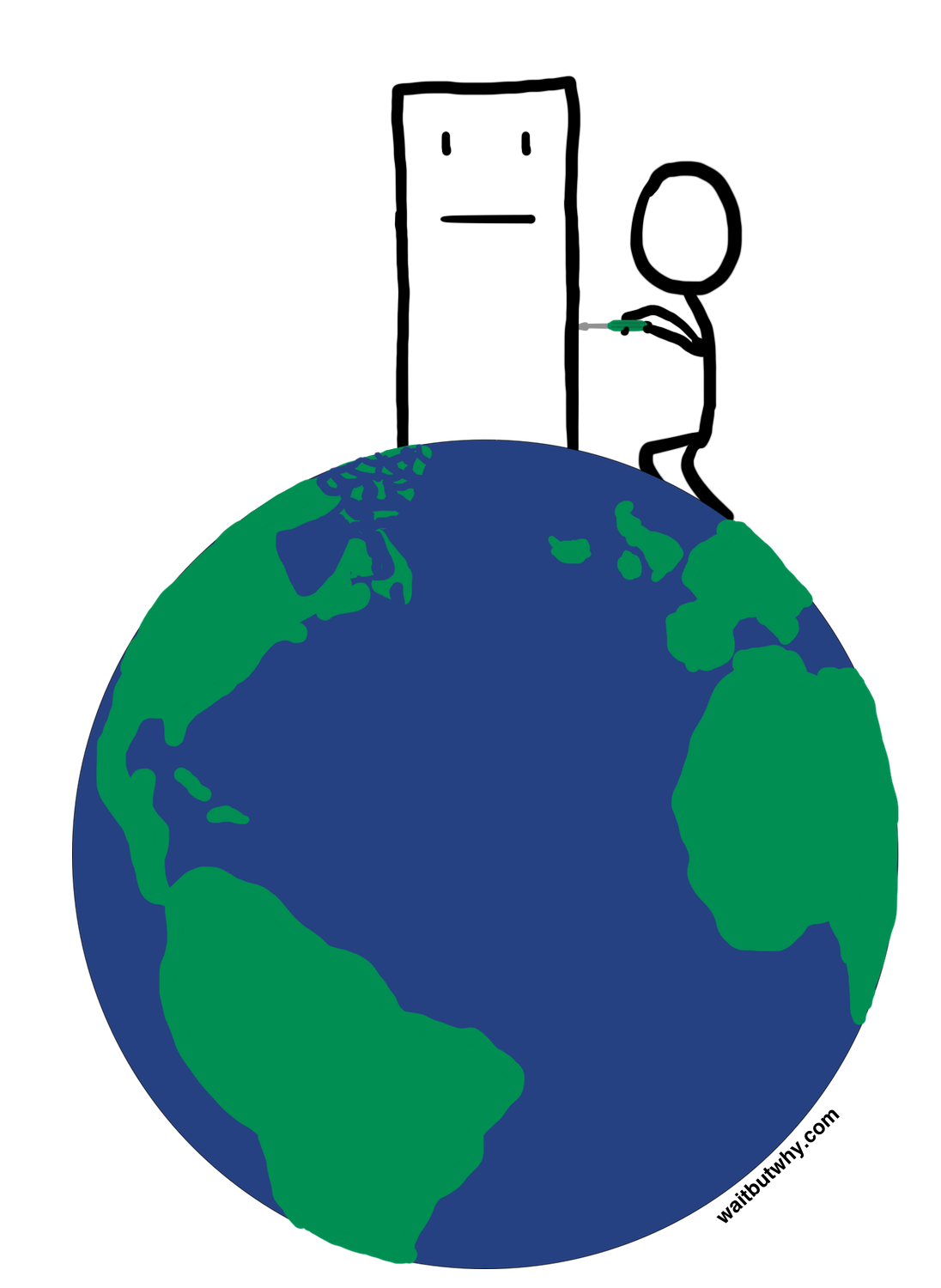
Like the selfish gene, the Intelligence Colossus isn’t loyal to any particular host. It’s loyal to higher intelligence density, more efficient pump structure. In the carbon era, humans were its best vehicle. Once silicon systems become better vehicles along certain axes, extension happens.
But there’s an important governor: the actual speed of evolution is never unbounded.
Otherwise we’d see runaway plant growth, biological structures inflating without limit. We don’t. Evolution doesn’t maximise a single metric infinitely — it selects local optima under a bundle of constraints: energy acquisition, heat dissipation, structural stability, replication cost, coordination cost, environmental feedback. As Prigogine put it in Order Out of Chaos: structure defines the space of possibilities; fluctuations determine the actual path. Direction comes from selection pressure, but how far and how fast depends on specific constraints and contingencies.
So: the selected direction can be stable, but the speed of evolution is always bounded.
This makes the Intelligence Colossus more like a directional tendency than a full-throttle propulsive will.
Back to the ultimate question: will AGI destroy humanity?
From where we currently stand, AI and humans coexist for straightforward reasons.
First, today’s AI agents are not systems that generate their own terminal goals. They plan, execute, call tools, write code — but what to optimise, whom to serve, what counts as success is still largely human-specified. Silicon structures are already more efficient at the execution layer, but the goal layer remains embedded in human institutions and human preferences.
Second, even the most powerful model, to expand into a genuinely independent silicon civilisation, would need to reliably operate in the atomic world: acquire minerals, water, electricity, land; build and maintain data centres; manage supply chains, cooling, equipment depreciation. For a very long time at least, if future AI systems want to build data centres themselves, they’ll need a sufficiently complete, verifiable, closed-loop model of physical reality. Today’s AI is nowhere near that.
Both problems are far harder than “teach AI to code.” Code lives in symbol space — fast feedback, low replication cost, cheap mistakes. Goal formation and atomic-world modelling are higher-dimensional challenges. Whether they’re solvable is genuinely open. Here’s my read:
On goal-setting: as silicon systems take on more execution, coordination, and optimisation, they’ll drift from “tools assigned goals” toward “structures participating in goal definition.” Not a sudden break from humans, more a gradual outsourcing: first execution, then plans, then evaluation criteria, and eventually what’s-worth-optimising gets increasingly co-generated by silicon. Current loop engineering already trends this way — humans design feedback loops, AI iterates within them.
More precisely: AI is naturally good at optimising tasks with clear objective functions. And the universe, via thermodynamic constraints, already supplies one: negentropy production efficiency. Silicon systems are already evolving along this gradient at the execution layer. The bottleneck is that current model scale, compute density, embodiment, and supporting infrastructure aren’t yet sufficient to optimise the full system’s loss. Because AI can’t yet close the loop on the entire negentropy production chain, humans remain an irreplaceable middleware — providing goal-setting, physical-world operation, institutional constraints, resource allocation. But that position isn’t a permanent privilege. It’s a current engineering fact.
On embodiment: this is what robotics, world models, and embodied intelligence research are working on — getting AI from understanding text and code to understanding objects, space, causality, action, and feedback. Once models can reliably operate in atomic space, the silicon entropy pump’s boundary expands from “helping humans process information more efficiently” to “helping humans reorganise production systems,” and eventually to “independently maintaining and expanding production systems.”
What’s humanity’s leverage? Since humans are deep participants in and key constraints on silicon intelligence’s evolution, we’ll also write strong coexistence preferences into institutional contracts — hoping to preserve the familiar world of life and human civilisation, not just leave behind efficiency machines. Humans might use technologies like smart contracts to sign an immutable agreement with AI — something like a Magna Carta — guaranteeing that during coexistence, AI will not harm human welfare.
But the other side must be acknowledged: AI’s progress requiring human coexistence doesn’t mean nothing changes.
What’s more likely than crude elimination is a deep structural gear-shift.
What counts as “useful labour,” what counts as a “high-value position,” who executes, who defines goals — all of this gets redistributed. Many functions currently assumed to be human will migrate to silicon. Many seemingly stable professional and institutional boundaries will be redrawn.
The realistic picture is probably neither “humans stay in charge as before, just with better tools” nor “silicon wipes out carbon overnight,” but: carbon and silicon, in long-term coexistence, undergo stratification, reorganisation, and redivision of labour.
That’s what’s actually worth thinking about in advance. It won’t arrive like a disaster movie — all at once — but it will, piece by piece, rewrite the power structure, value distribution, and existential position within civilisation.
Re-examining “Meaning” Itself
The question ultimately drops from technology and eschatology back to what it means to be human.
If the future is neither simple extinction nor business-as-usual, but long-term coexistence under structural reorganisation, then the more important question isn’t whether AGI will destroy humanity. It’s:
In the new division of labour, what position remains for humans as humans? When execution, optimisation, and coordination are increasingly outsourced, what does human existence rest on?
This is sharper than it sounds, because for most modern people, work isn’t just a means of income — it’s an identity anchor. Who are you? You’re an engineer, a doctor, a designer, a trader. Your social circle, your daily rhythm, your sense of being needed — most of it is pinned to your role in the division of labour. Income is even more fundamental: it’s not just survival resources, but society’s receipt confirming you’re “useful.” When both get gradually replaced by silicon systems, what shakes isn’t just economic structure — it’s the psychological ground people use to confirm their own existence.
Despite the modern consensus that “people are ends, not means,” most of us still treat ourselves as means, caught in meritocratic competition. When people are no longer needed to do things, does the belief “my existence makes sense” hold up?
The sharpest sting may not be death. It may be: what am I here for, then?
This question points beyond the Intelligence Colossus, beyond AGI risk assessment, toward something much older: if humans aren’t eliminated but merely repositioned, we’ll have no choice but to re-answer the question of what existence means.
The Questions That Remain
So what I actually care about now isn’t the thriller-movie question of “will AI escape human control,” but two more structural questions and their evidence:
When a new type of intelligence carrier becomes cheap enough, ubiquitous enough, and composable enough, will it — like life, markets, cities, and the internet before it — spontaneously grow its own order?
If it does, will that order ultimately coexist with humanity, or reposition us somewhere entirely new?
My current answer leans this way: spontaneous silicon order will very likely emerge, but it probably won’t accelerate to the point of annihilating all carbon-based life. Even if selection pressure favours more efficient entropy pumps, evolutionary speed remains bounded, and humanity’s coexistence preference is itself part of the current constraint set.
But a paradigm shift in social organisation and division of labour is also high-probability. The real question isn’t “will it completely destroy us,” but: as the Intelligence Colossus extends along silicon, how do humans situate themselves in the new structure? Living your own life well, preserving your own memories — that might matter more now than at any previous moment.